
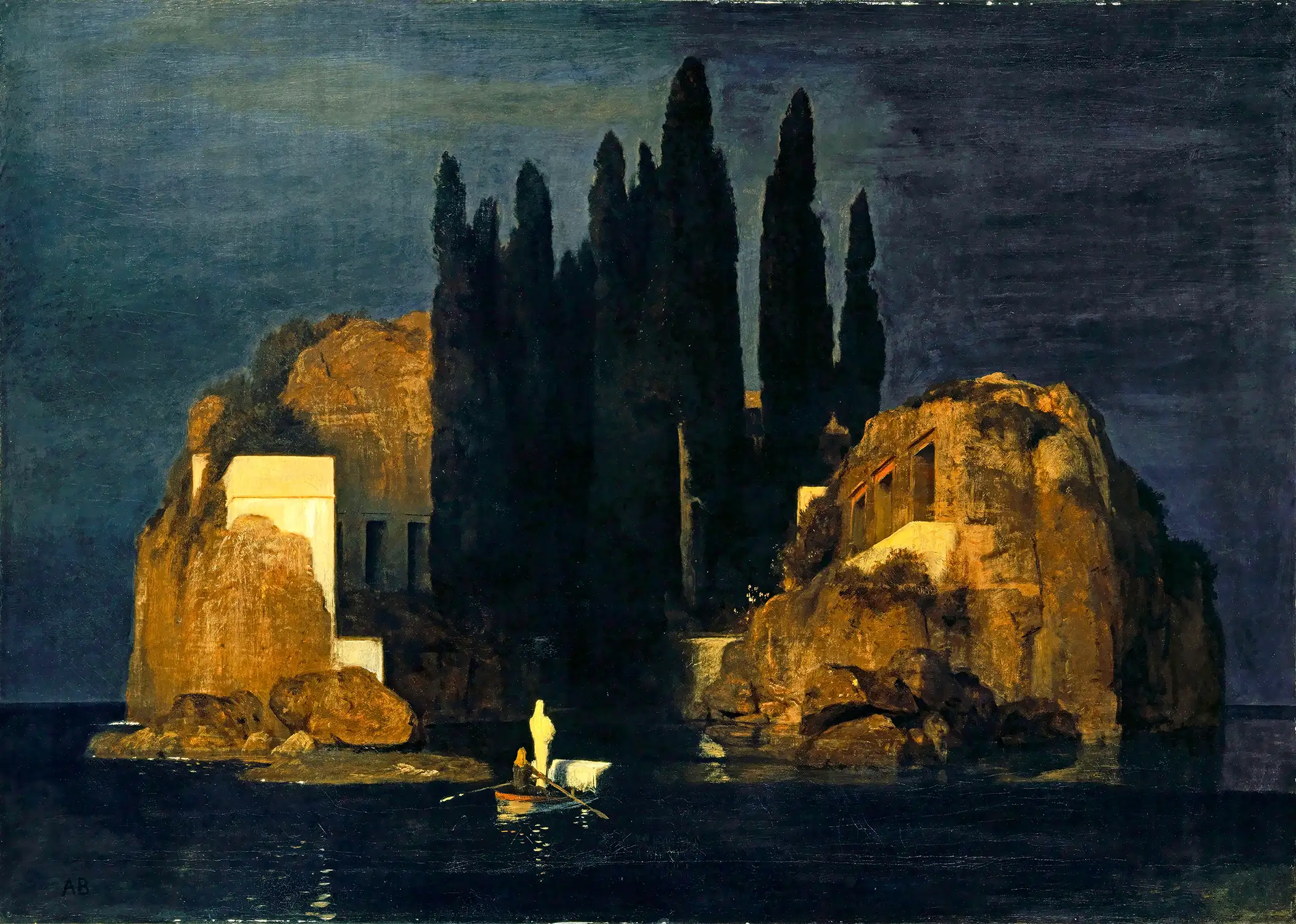
Arnold Böcklin – Isle of the Dead (1880)
Original price was: $9.99.$4.99Current price is: $4.99.
Arnold Böcklin – Isle of the Dead (1880)
Description
This work of art has been digitally enhanced without erasing signs of ageing for the sake of authenticity. Digital paintings are very popular right now as an affordable and stylish way to decorate and personalize your home and office.
Arnold Böcklin – Isle of the Dead (1880)
“Isle of the Dead (German: Die Toteninsel) is the best-known painting of Swiss Symbolist artist Arnold Böcklin (1827–1901). Prints were very popular in central Europe in the early 20th century—Vladimir Nabokov observed in his 1936 novel Despair that they could be “found in every Berlin home”.
Böcklin produced several different versions of the painting between 1880 and 1886, which today are exhibited in Basel, New York City, Berlin, and Leipzig. A sixth version, begun in autumn 1900 with the help of Böcklin’s son Carlo Böcklin and finished by Carlo in 1901, is part of the Hermitage Museum’s collection in Saint Petersburg.
All versions of Isle of the Dead depict a desolate and rocky islet seen across an expanse of dark water. A small rowing boat is just arriving at a water gate and seawall on shore. An oarsman maneuvers the boat from the stern. In the bow, facing the gate, is a standing figure clad entirely in white. Just ahead of the figure is a white, festooned object commonly interpreted as a coffin. The tiny islet is dominated by a dense grove of tall, dark cypress trees—associated by long-standing tradition with cemeteries and mourning—which is closely hemmed in by precipitous cliffs. Furthering the funerary theme are what appear to be sepulchral portals and windows on the rock faces.
Böcklin himself provided no public explanation as to the meaning of the painting, though he did describe it as “a dream picture: it must produce such a stillness that one would be awed by a knock on the door”. The title, which was conferred upon it by the art dealer Fritz Gurlitt in 1883, was not specified by Böcklin, though it does derive from a phrase in an 1880 letter he sent to the painting’s original commissioner.
Not knowing the history of the early versions of the painting, many observers have interpreted the oarsman as representing the boatman Charon, who ferried souls to the underworld in Greek mythology. The water would then be either the River Styx or the River Acheron, and his white-clad passenger a recently deceased soul transiting to the afterlife.”
After purchase you will have access to a PDF document with a link to these files available for download: 5×7”, 7×10”, 9×12”, 10×14”, 14×20″, 17×24″, 26×36″ and A1.
All files are in JPG format and at 300 PPI/DPI resolution. Please note that colours on your screen may be slightly different from the actual print.
This is not a physical item therefore nothing will be shipped to you.
You can download the PDF file at checkout after the payment clears.
Since these are printable downloads, refunds cannot be issued. Should you have any issues or questions please contact us and we will be happy to assist you.
For personal use only. Please do not use our digital art files for commercial use or resale.
© NovemaDigital
Only logged in customers who have purchased this product may leave a review.
Related products
-
Sale!

Otto Geigenberger – Spitz in der Wachau (1938)
Original price was: $9.99.$4.99Current price is: $4.99. -
Sale!
Auguste Renoir – Figures on the Beach (1890)
Original price was: $9.99.$4.99Current price is: $4.99. -
Sale!
George Benjamin Luks – Winter, High Bridge Park (1913)
Original price was: $9.99.$4.99Current price is: $4.99. -
Sale!
Lucas van Valckenborch – Winter Landscape with Snowfall near Antwerp (1575)
Original price was: $9.99.$4.99Current price is: $4.99.

Reviews
There are no reviews yet.