
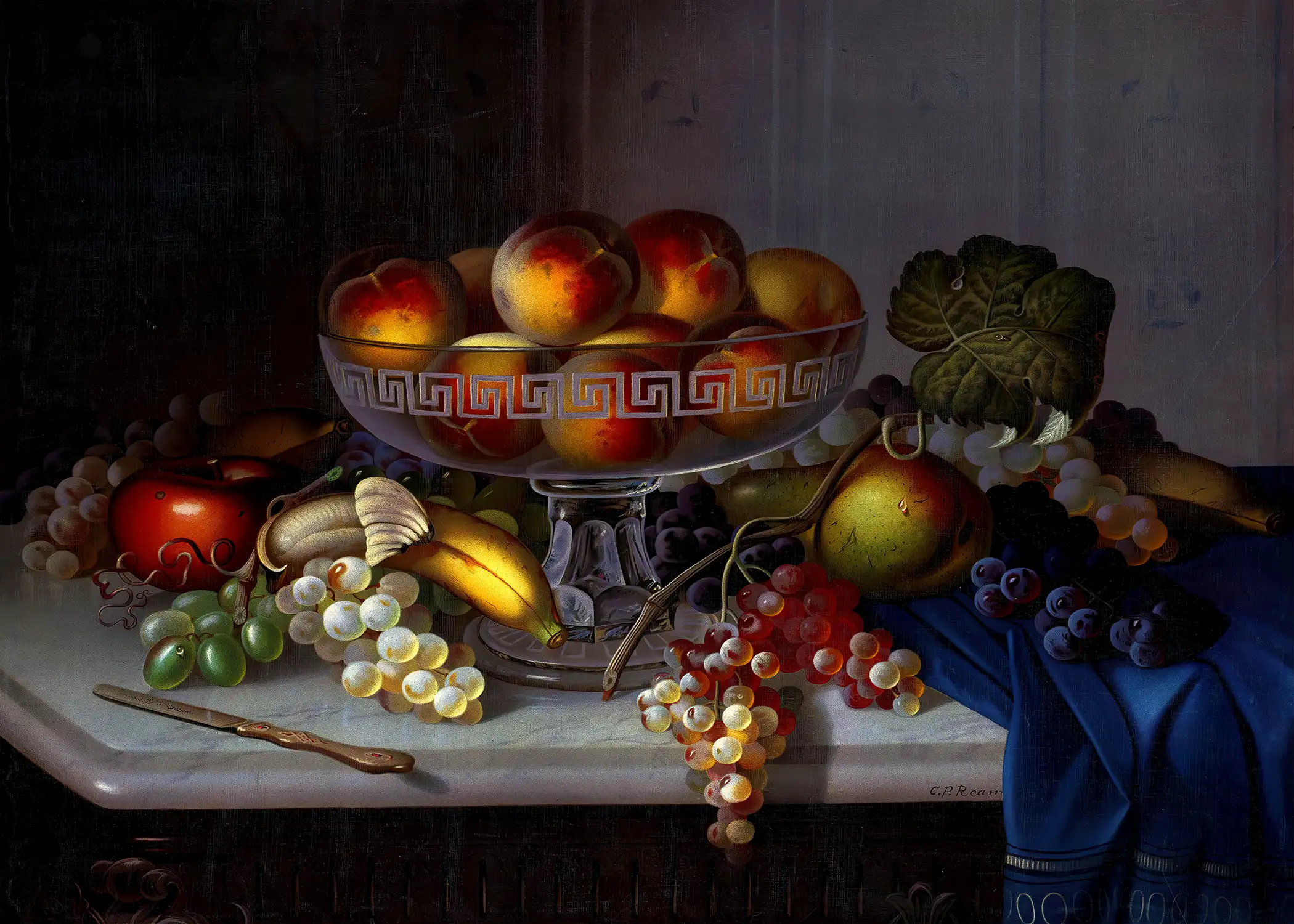
Carducius Plantagenet Ream – Still Life (c.1873)
Original price was: $9.99.$4.99Current price is: $4.99.
Carducius Plantagenet Ream – Still Life (c.1873)
Description
This work of art has been digitally enhanced without erasing signs of ageing for the sake of authenticity. Digital paintings are very popular right now as an affordable and stylish way to decorate and personalize your home and office.
Carducius Plantagenet Ream – Still Life (c.1873)
“Cadurcis Plantagenet Ream, also referred to as Carducius Plantagenet Ream was an American still-life painter who specialized in fruit. The currently available art gallery and biographical sources are almost evenly divided as to what his actual first name was. Some give both.
His father, Jonas Alexander Ream (1809-1882), a country lawyer, was originally from Pennsylvania. His younger brother, Morston Constantine Ream (1840-1898), also became a still-life painter. He first expressed an interest in art at the age of ten, and most sources indicate that he was self-taught. In the late 1850s, he displayed some of his first works at a photography shop owned by R. B. Douglas in Cleveland.
Around 1866, he moved to New York and sold some works at an auction in the Henry H. Leeds & Miner art gallery. In the 1870s he began a collaboration with the lithographer Louis Prang to create a series of works under the title “Desserts”. Later, he opened a studio with his brother, Morston.
Seeking new markets, he moved to Chicago in 1878 and established a studio with (Judge Freer?). He soon began to exhibit regularly at the Art Institute of Chicago. This led to showings at the National Academy of Design, the Brooklyn Art Association and the Royal Academy of London. He was one of the first artists to hire professional “boosters” to advertise his works and he held his own auctions. In the 1880s, he often travelled to Europe, which included some time at the Academy of Fine Arts, Munich, spent with his fellow Ohioan, Frank Duveneck.
In 1882, he married Maria Gatzmeyer, a Franco-German from Hanover, who was twenty-six years his junior. She and their only son apparently remained in Germany, where he spent at least three months out of every year.
In 1899, his painting “Purple Plums” became the first work by a local artist to be included in the permanent collection at the Institute. By 1900, he was suffering from multiple health problems, including deafness. His last exhibit was at the Institute in 1909, when he became paralyzed in his right hand, probably from a stroke. By 1913, he was bedridden and remained so until his death.”
After purchase you will have access to a PDF document with a link to these files available for download: 5×7”, 8×10”, 9×12”, 11×14”, 16×20″, 18×24″, 24×36″ and A1.
All files are in JPG format and at 300 PPI/DPI resolution. Please note that colours on your screen may be slightly different from the actual print.
This is not a physical item therefore nothing will be shipped to you.
You can download the PDF file at checkout after the payment clears.
Since these are printable downloads, refunds cannot be issued. Should you have any issues or questions please contact us and we will be happy to assist you.
For personal use only. Please do not use our digital art files for commercial use or resale.
© NovemaDigital
Only logged in customers who have purchased this product may leave a review.
Related products
-
Sale!

Vincent van Gogh – View from Montmartre (1886)
Original price was: $9.99.$4.99Current price is: $4.99. -
Sale!
Walter Moras – Winter II (1856-1925)
Original price was: $9.99.$4.99Current price is: $4.99. -
Sale!
Canaletto – Campo Santa Maria Zobenigo, Venice (1730s)
Original price was: $9.99.$4.99Current price is: $4.99. -
Sale!
Walter Moras – Winter (1856-1925)
Original price was: $9.99.$4.99Current price is: $4.99.



Reviews
There are no reviews yet.