
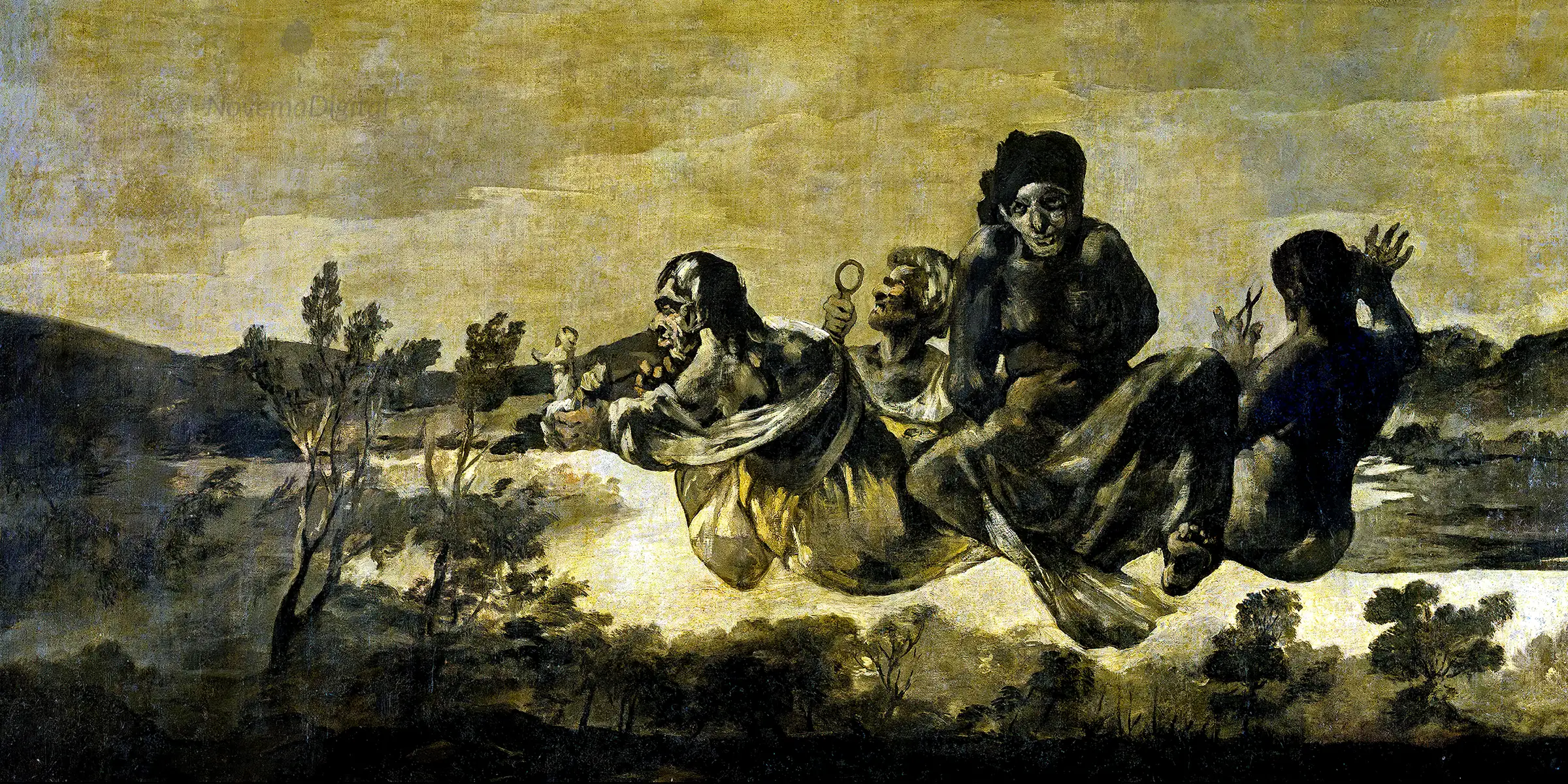
Francisco Goya – Átropos o Las Parcas (1819-1823)
Original price was: $9.99.$4.99Current price is: $4.99.
Francisco Goya – Átropos o Las Parcas (1819-1823)
Description
This work of art has been digitally enhanced without erasing signs of ageing for the sake of authenticity. Digital paintings are very popular right now as an affordable and stylish way to decorate and personalize your home and office.
Francisco Goya – Átropos o Las Parcas (1819-1823)
“Atropos, or The Fates (Spanish: Átropos or Las Parcas) is one of the 14 Black Paintings painted by Francisco de Goya between 1819–1823. Goya, then 75 and in mental and physical despair, created the series directly onto the interior walls of the house known as the Quinta del Sordo (“House of the Deaf Man”), purchased in 1819.
It probably occupied a position on the second floor of the house beside the Fight with Cudgels and across from the Fantastic Vision. Like the rest of the black paintings, it was transferred to canvas in 1873–74 under the supervision of Salvador Martínez Cubells, a curator at the Museo del Prado. The owner, Baron Emile d’Erlanger, donated the canvases to the Spanish state in 1881, and they are now on display at the Prado.
The painting is a reinterpretation of the mythological subject of the goddesses of destiny—the Moirai or fates as recounted in Homer, Hesiod, Virgil and other classical writers. These “Daughters of Night” were headed by Atropos, the inexorable goddess of death, who carries a few scissors to cut the thread of life; Clotho, with her distaff (which Goya replaces with a doll or newborn child, possibly an allegory of life), and Lachesis, the spinning one, which in this representation looks across a lens or in a mirror and symbolizes time, since she was the one who measured the length of the fibre. To the three female figures suspended in the air a fourth figure is added in the foreground. Possibly male, this figure’s hands are bound behind him as if he is captive. If this interpretation is true, the fates would be deciding the destiny of the man whose bound hands cannot be opposed to his fate. It has been speculated that he may represent Prometheus, who was bound on a mountain and left to be savaged by an eagle as punishment for stealing fire from Mount Olympus.
The painting’s range of color is diminished, as much or even more so than the other black paintings, to ochre and black. This reinforces a nocturnal and unreal atmosphere, appropriate to the mythical subject of this work. The arbitrary, irrational aspects of Goya’s Black Paintings have given them a place as precursors to modern art.”
After purchase you will have access to a PDF document with a link to these files available for download: 4×8”, 5×10”, 6×12”, 8×16”, 10×20”, 12×24”, 15×30” and 20×40”.
All files are in JPG format and at 300 PPI/DPI resolution. Please note that colours on your screen may be slightly different from the actual print.
This is not a physical item therefore nothing will be shipped to you.
Since these are printable downloads, refunds cannot be issued. Should you have any issues or questions please contact us and we will be happy to assist you.
For personal use only. Please do not use our digital art files for commercial use or resale.
© NovemaDigital
Only logged in customers who have purchased this product may leave a review.
Related products
-
Sale!

Vincent van Gogh – Fishing in Spring, The Pont de Clichy, Asnières (1887)
Original price was: $9.99.$4.99Current price is: $4.99. -
Sale!
Auguste Renoir – Figures on the Beach (1890)
Original price was: $9.99.$4.99Current price is: $4.99. -
Sale!
Vincent van Gogh – View from Montmartre (1886)
Original price was: $9.99.$4.99Current price is: $4.99. -
Sale!

Kerstiaen de Keuninck – A Mountainous Landscape with a Waterfall (1600s)
Original price was: $9.99.$4.99Current price is: $4.99.


Reviews
There are no reviews yet.