
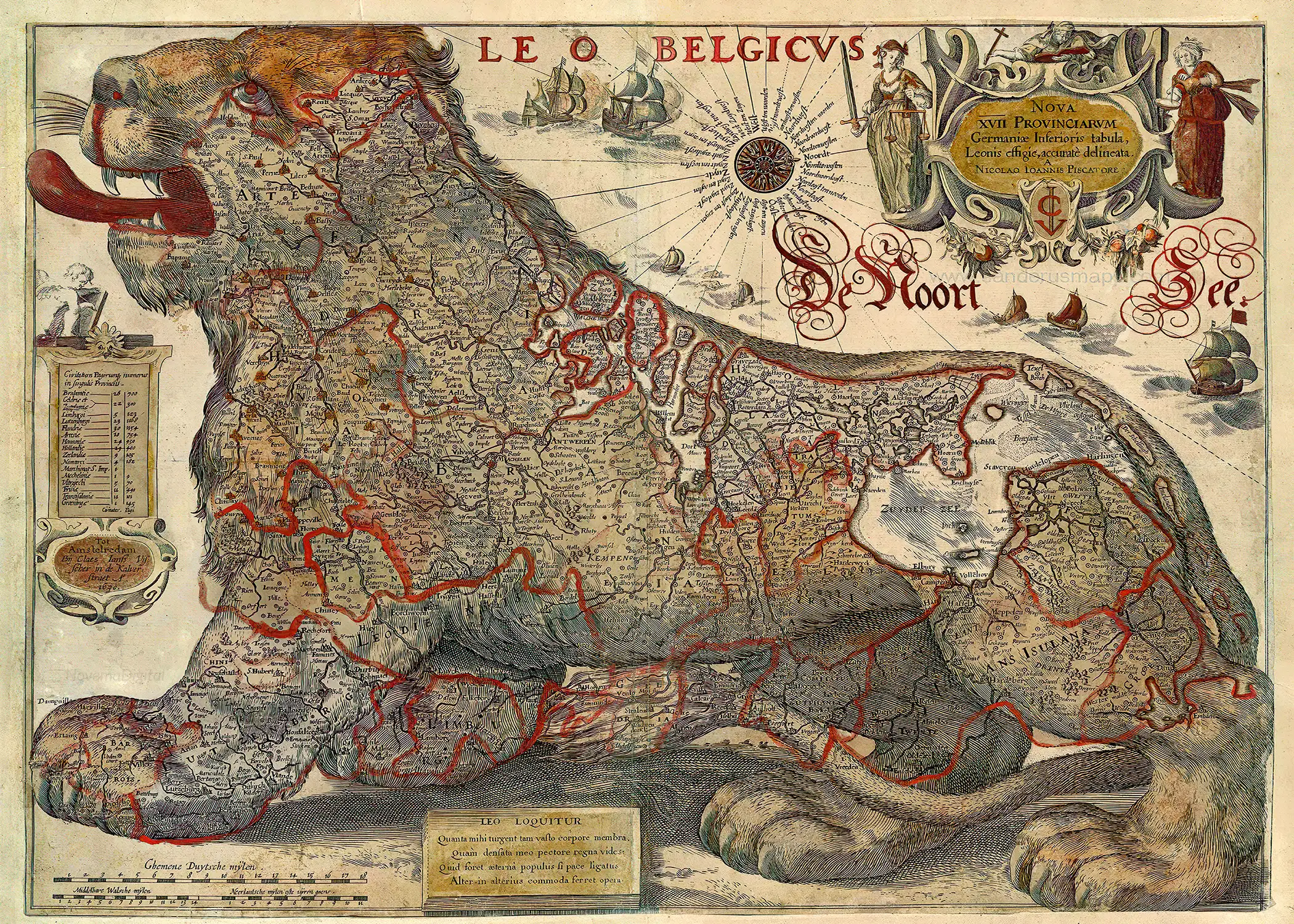
Hondius & Gerritsz – Leo Belgicus (1630)
Original price was: $9.99.$4.99Current price is: $4.99.
Hondius & Gerritsz – Leo Belgicus (1630)
Description
This work of art has been digitally enhanced without erasing signs of ageing for the sake of authenticity. Digital paintings are very popular right now as an affordable and stylish way to decorate and personalize your home and office.
Hondius & Gerritsz – Leo Belgicus (1630)
“The Leo Belgicus (Latin for Belgic Lion) was used in both heraldry and map design to symbolize the former Low Countries (current day Netherlands, Luxembourg, Belgium and a small part of northern France) with the shape of a lion. When not in map form, the Leo Belgicus often accompanies the Dutch Maiden, the national personification of the Dutch Republic. Often both sit in a circular fenced enclosure, the “Garden of Holland”. Europa regina, showing Europe as a queen, was a comparable schematic.
The names derived from the Belgae (and thus including Belgica) are now mostly identified with the country Belgium; yet before the division of the Low Countries into a southern and a northern half in the 16th century, it was a common name for the entire Low Countries, and was the usual Latin translation of the Netherlands (which at that point covered the current territory of the Netherlands, Luxembourg, Belgium and a small part of northern France). Several somewhat later maps of the Dutch Republic, which consisted of the Northern Netherlands, and therefore has almost no intersection with the present country of Belgium, also show the Latin title Belgium Foederatum. Also, a 17th-century colonial province that was located on the East Coast of North America — which was ruled and settled exclusively by the Dutch Republic and in which the present Belgium had no share — was known in Dutch as Nieuw-Nederland but in Latin as Nova Belgica or Novum Belgium.
The earliest Leo Belgicus was drawn by the Austrian cartographer Michaël Eytzinger in 1583, when the Netherlands were fighting the Eighty Years’ War for independence. The motif was inspired by the heraldic figure of the lion, occurring in the coats of arms of several of the Netherlands, namely: Brabant, Flanders, Frisia, Guelders, Hainaut, Holland, Limburg, Luxembourg, Namur and Zeeland, as well as in those of William of Orange.
Eytzinger’s map was the first of many. There were three different designs. In the most common one, the lion’s head was located in the northeast of the country and the tail in the southeast. The most famous version is that of Claes Janszoon Visscher, which was published in 1609 on the occasion of the Twelve Years’ Truce. A less common design reversed the position of the lion, as shown in the Leo Belgicus by Jodocus Hondius.
The third version was published in the later stages of the war, and after the independence of the Dutch Republic was confirmed in the Peace of Westphalia (1648). It is called the Leo Hollandicus, the Holland Lion, and shows only the province of Holland. One of the earliest versions was published by Visscher around 1625.”
After purchase you will have access to a PDF document with a link to these files available for download: 5×7”, 8×10”, 9×12”, 11×14”, 16×20″, 18×24″, 24×36″ and A1.
All files are in JPG format and at 300 PPI/DPI resolution. Please note that colours on your screen may be slightly different from the actual print.
This is not a physical item therefore nothing will be shipped to you.
Since these are printable downloads, refunds cannot be issued. Should you have any issues or questions please contact us and we will be happy to assist you.
For personal use only. Please do not use our digital art files for commercial use or resale.
© NovemaDigital
Only logged in customers who have purchased this product may leave a review.
Related products
-
Sale!

Paul Signac – Evening Calm, Concarneau, Opus 220 (Allegro Maestoso) (1891)
Original price was: $9.99.$4.99Current price is: $4.99. -
Sale!
Stanisław Witkiewicz – Spring Landscape with a Pond (1902)
Original price was: $9.99.$4.99Current price is: $4.99. -
Sale!
Auguste Renoir – Figures on the Beach (1890)
Original price was: $9.99.$4.99Current price is: $4.99. -
Sale!
Otto Geigenberger – Spitz in der Wachau (1938)
Original price was: $9.99.$4.99Current price is: $4.99.


Reviews
There are no reviews yet.