
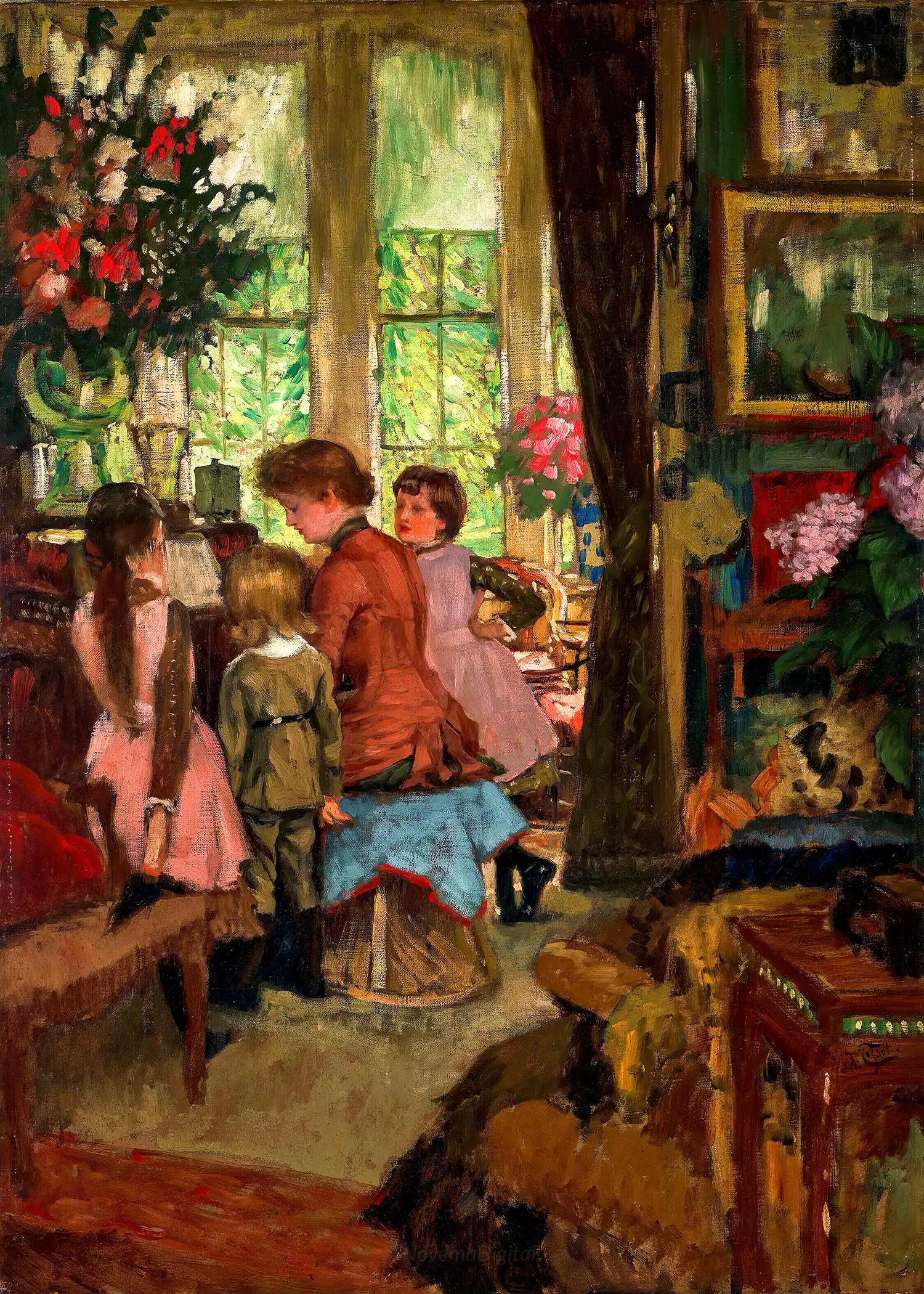
James Tissot – Kathleen Newton at the Piano (c.1881)
Original price was: $9.99.$4.99Current price is: $4.99.
James Tissot – Kathleen Newton at the Piano (c.1881)
Description
This work of art has been digitally enhanced without erasing signs of ageing for the sake of authenticity. Digital paintings are very popular right now as an affordable and stylish way to decorate and personalize your home and office.
James Tissot – Kathleen Newton at the Piano (c.1881)
“Kathleen Irene Ashburnham Newton (née Kelly; 1854–1882) was the Irish muse and lover of French artist James Tissot.
James Tissot had enjoyed a decade of artistic success in Paris, specialising in modern life and historical-dress pictures, before the Franco-Prussian War and siege of Paris in 1870-1871. After his involvement in the events of the 1871 Paris Commune, he was offered work in London, where he found eager buyers for his pictures and was able, by late 1872, to buy a house in Grove End Road. He relied on a range of sitters, but from 1877-1882 his most frequent, and often only, model was Kathleen Newton. According to Kathleen’s niece Lilian Hervey, Tissot “could scarcely help noticing the pretty Mrs Newton” going past his house and “called to ask if he might paint her portrait. Over the sittings [presumably for the etched Portrait of Mrs N.] they fell deeply in love, and soon [in 1877] Mrs Newton went to live with Tissot.” Her children remained at Hill Road with their aunt, cousins, and shared nanny, but visited Tissot’s house for picnics and entertainment.
Tissot and Kathleen lived together openly as man and wife. They were unable to marry, as Tissot was a Roman Catholic and divorce is not recognised by the Catholic Church. Annulment may have been possible but would have made her children illegitimate, a situation she had sought to avoid by registering their father as Dr Newton. Cohabitation was not uncommon at this time, especially among artists, but was disapproved of by many people. The couple’s social sphere became limited to those who did not disapprove. “They had their own little literary and artistic circles,” said Lilian, “in which the absence of a conventional wedding ring made no difference,” including James McNeill Whistler, “Oscar Wilde with his brother Willie, Sir Charles Wyndham, Sir Henry Irving and Miss Mary Moore.” Thomas Gibson Bowles, founder of the satirical weekly Vanity Fair and a longstanding friend of Tissot, was also a frequent visitor, and introduced others such as William Stone, “The Squire of Piccadilly”, who recalled being “a good deal up at 17 Grove End Road and often had tea in the garden with Tissot and the lady.” According to Stone, “Tissot was quite a boulevardier and could not grasp our somewhat puritanical outlook [on cohabitation]”. Lilian said that “to the servants, Mrs Newton was always ‘Madame Tissot’. She called her lover ‘Jimmie’, and he addressed her invariably as ‘petite femme’.”
After purchase you will have access to a PDF document with a link to these files available for download: 5×7”, 8×10”, 9×12”, 11×14”, 16×20″, 18×24″, 24×36″ and A1.
All files are in JPG format and at 300 PPI/DPI resolution. Please note that colours on your screen may be slightly different from the actual print.
This is not a physical item therefore nothing will be shipped to you.
You can download the PDF file at checkout after the payment clears.
Since these are printable downloads, refunds cannot be issued. Should you have any issues or questions please contact us and we will be happy to assist you.
For personal use only. Please do not use our digital art files for commercial use or resale.
© NovemaDigital
Only logged in customers who have purchased this product may leave a review.
Related products
-
Sale!

Giovanni Battista Tiepolo – Allegory of the Planets and Continents (1752)
Original price was: $9.99.$4.99Current price is: $4.99. -
Sale!
Henri Rousseau – The Banks of the Bièvre near Bicêtre (1900s)
Original price was: $9.99.$4.99Current price is: $4.99. -
Sale!

Utagawa Hiroshige – The Monkey Bridge in Kai Province (1840s)
Original price was: $9.99.$4.99Current price is: $4.99. -
Sale!
Walter Launt Palmer – Winter Glow (1892)
Original price was: $9.99.$4.99Current price is: $4.99.


Reviews
There are no reviews yet.