
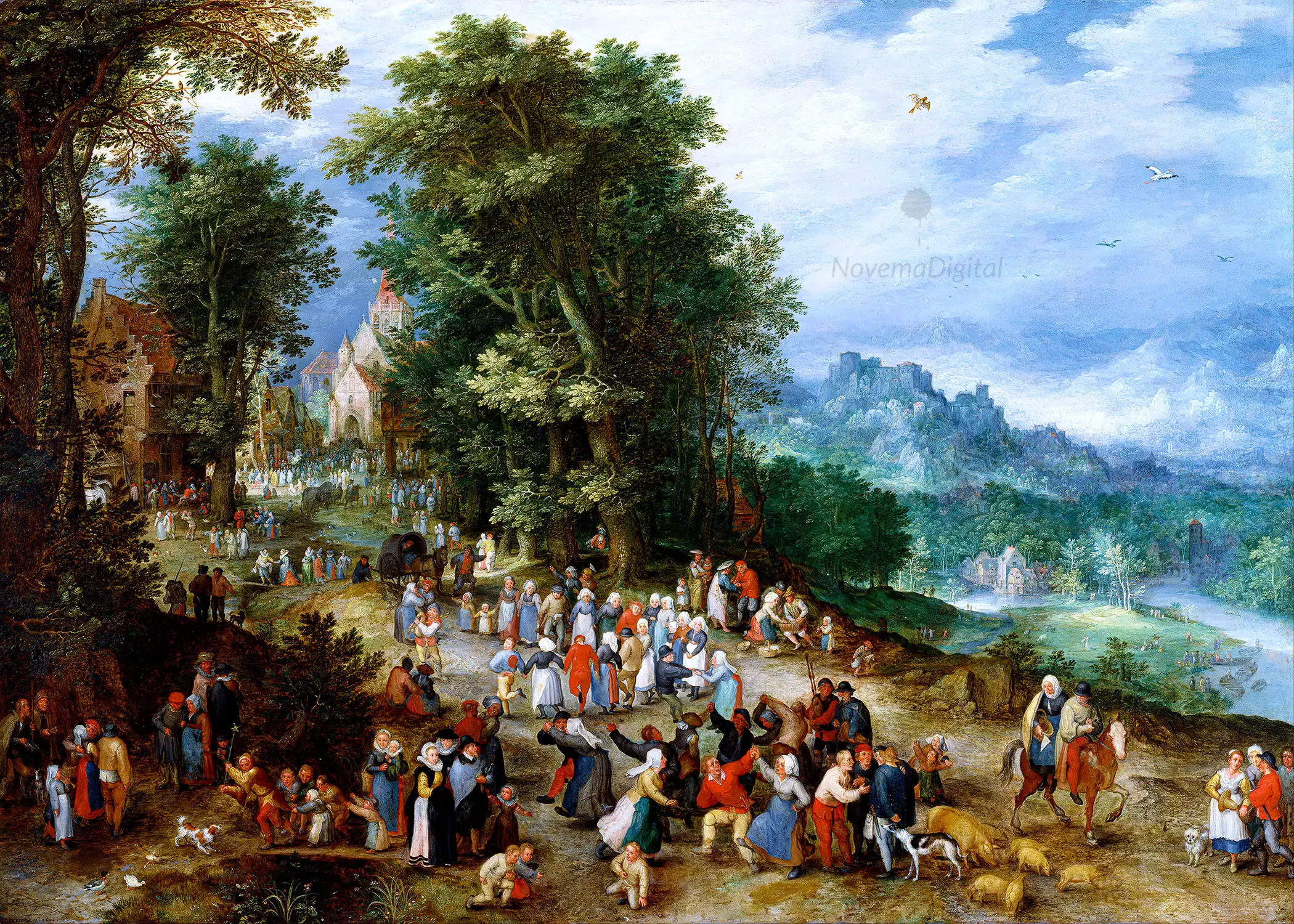
Jan Brueghel the Elder – A Flemish Fair (1600)
Original price was: $9.99.$4.99Current price is: $4.99.
Jan Brueghel the Elder – A Flemish Fair (1600)
Description
This work of art has been digitally enhanced without erasing signs of ageing for the sake of authenticity. Digital paintings are very popular right now as an affordable and stylish way to decorate and personalize your home and office.
Jan Brueghel the Elder – A Flemish Fair (1600)
“This magnificent landscape depicts a Kermis or fair, during which a religious festival is celebrated by a rustic street party. The subject had been treated by Pieter Bruegel the Elder, in his Peasant Dance of c.1568 as a ‘Vanity Fair’ of drink-fuelled folly and vice. Jan Brueghel by contrast sees the Kermis as an emblem of the happiness of a well-ordered society at play. He adopts his father’s technique, of the universal panorama of life, with as many legible mini-incidents as space and ingenuity permit.
This small copper is an inexhaustible record of life, which its original owner must have spent many hours reading. In the background bystanders kneel before the religious procession approaching the church. The pub in the left background is full; amongst many groups we can just make out a ring of peasants playing dice on a tree-stump table. In the middle ground two groups of peasants dance in a ring to the sound of bagpipes and hurdy-gurdy; a pair of children are trying to learn the same moves. One elderly woman in the near group has a ring of keys held on a cord, which flies out from her waist as she spins. Behind the nearer ring to the right there is a toy-seller (who has recently sold a hobbyhorse), a beggar or peddler in red talking to a man and his wife.
The festivities are enjoyed by two groups of prosperous middle-class observers: one group of gallant young lovers (in the middle ground) have courtly manners which contrast with the peasant couple billing in the cart; the nearer group seems to include three generations of a single family, with their nursemaid. A jester is chased away (or possibly restrained with demands for an encore) by a group of children. Some beggars arrive at the extreme left foreground; children play with a ball across the centre; and an elderly couple share a ride home to the right, taking their flag and a basket full of produce.
It is difficult not to see this as a celebration of the abatement of the war and an expression of hope for a lasting peace. This is an early example of a type of image, which defined the hopes and ideals of the rule of the Archdukes Albert and Isabella. Later examples of this subject, also by Jan Brueghel (Prado, dated 1623), depict the Archdukes themselves watching the festivities, as the city-dwellers do here.
The distance here has exactly the same combination of Low Country foreground and Alpine distance seen in Pieter Bruegel the Elder’s work. Jan Brueghel here loses the mountains in the clouds with an indistinctness especially admired by the English theorist Edward Norgate, who advises artists to ‘expresse your remonte Mountaines and grounds with a certaine airie Morbidezza or softnes, which is another remarkable grace and ornament of your worke’.”
After purchase you will have access to a PDF document with a link to these files available for download: 5×7”, 8×10”, 9×12”, 11×14”, 16×20″, 18×24″, 24×36″ and A1.
All files are in JPG format and at 300 PPI/DPI resolution. Please note that colours on your screen may be slightly different from the actual print.
This is not a physical item therefore nothing will be shipped to you.
Since these are printable downloads, refunds cannot be issued. Should you have any issues or questions please contact us and we will be happy to assist you.
For personal use only. Please do not use our digital art files for commercial use or resale.
© NovemaDigital
Only logged in customers who have purchased this product may leave a review.
Related products
-
Sale!

Alfred Sisley – Watering Place at Marly (1875)
Original price was: $9.99.$4.99Current price is: $4.99. -
Sale!
Auguste Renoir – Le Pont-Neuf (1872)
Original price was: $9.99.$4.99Current price is: $4.99. -
Sale!
Childe Hassam – Celia Thaxter’s Garden (1890)
Original price was: $9.99.$4.99Current price is: $4.99. -
Sale!
Vincent van Gogh – Green Wheat Fields, Auvers (1890)
Original price was: $9.99.$4.99Current price is: $4.99.

Reviews
There are no reviews yet.