
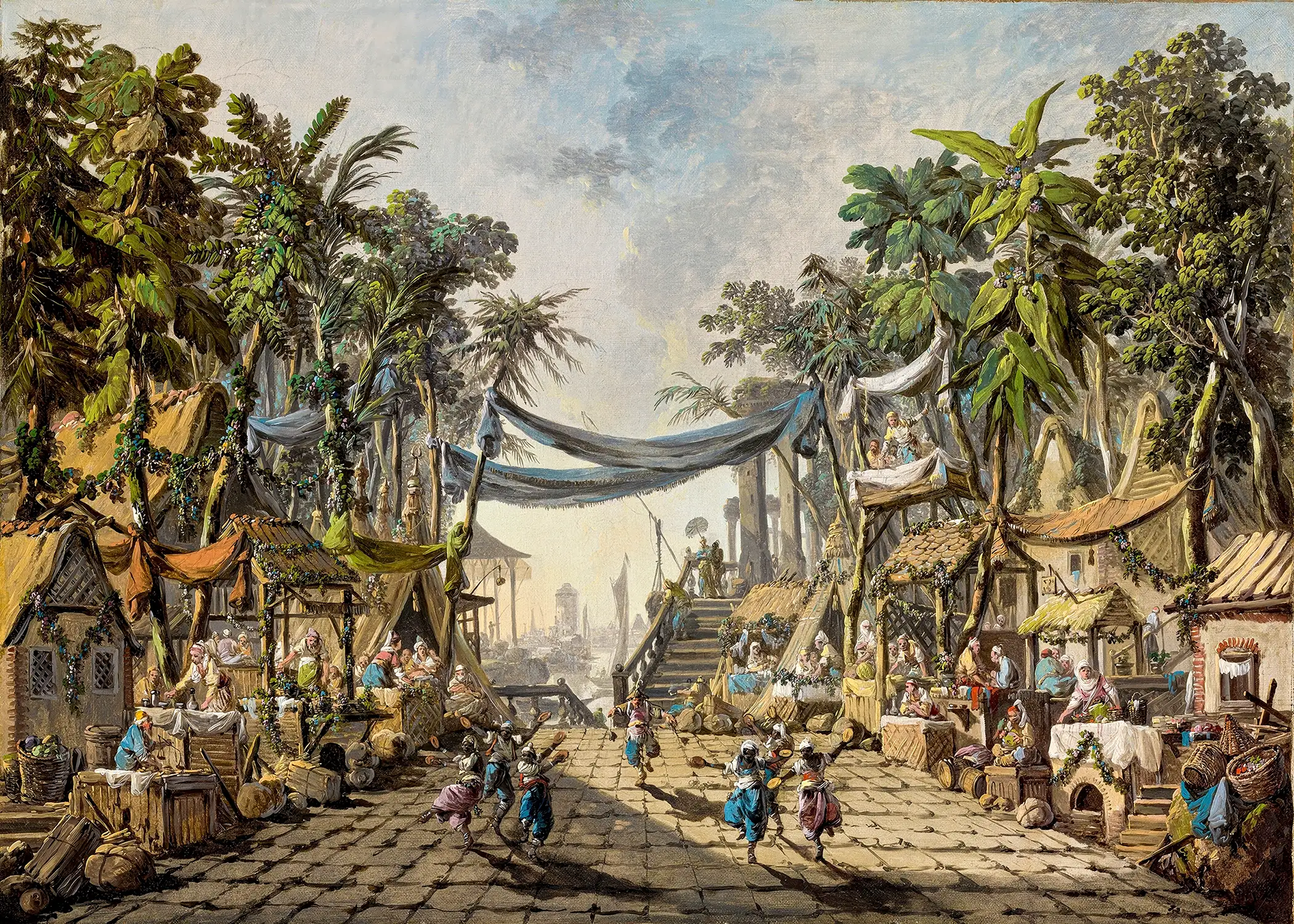
Jean-Baptiste Pillement – Market Scene in an Imaginary Oriental Port (c.1764)
Original price was: $9.99.$4.99Current price is: $4.99.
Jean-Baptiste Pillement – Market Scene in an Imaginary Oriental Port (c.1764)
Description
This work of art has been digitally enhanced without erasing signs of ageing for the sake of authenticity. Digital paintings are very popular right now as an affordable and stylish way to decorate and personalize your home and office.
Jean-Baptiste Pillement – Market Scene in an Imaginary Oriental Port (c.1764)
“Around 1764, French artist Jean-Baptiste Pillement painted this lively, imaginary marketplace meant to evoke a fantasy of the “Orient,” a term historically and broadly used for Asia. “Orient” derives from the Latin word for East, oriens, and refers to Asia’s geographic location relative to Europe. Pillement’s career and this painting captures the 18th century fascination with foreign, particularly Asian, cultures, which could be both admiring and derogatory.
Here, three groups of dancers perform in an open space framed by bustling stalls and lush tropical trees to the left and right. Merchants go about their business, conversing with one another, surveying their goods, and looking at the performers. In the center of the market, a man dances, holding a bell in each of his hands. Slightly in front of him on either side are two groups, each composed of three dark-complexioned dancers with cymbals. These characters are all balanced on one foot, caught mid-step in their energetic performance.
The variety of ethnic types in this scene—suggested by the costumes, skin tones, and exaggerated facial features—contributes to the idea that this is a port where people from different places interact. The man in blue holding scales in the front left appears to be a Chinese caricature by his cap and pointed beard, while the group in the back left seems to be of Turkish origin by the crescent moon atop their tent. Most people are wearing loose-fitting clothing and some wear turbans or headscarves, but it would be difficult to conclude where these people are specifically from or where this scene is taking place, though the locale is clearly differentiated from Europe.
At this moment, Europeans were particularly fascinated by Asian designs and customs due to a steady increase in travel, trade, and diplomacy with previously isolated or inaccessible regions of Asia. Imports like porcelain, lacquer, and textiles had become more available and in demand, and published accounts from missionaries and travelers provided abundant imagery for artists to draw upon and imitate.1 Like most Europeans, Pillement had a limited and secondhand understanding of foreign cultures and in his depictions of Asia he sometimes grouped and confused different cultures and people under the umbrella-term of “Oriental.” This widely-used label was applied to many regions east of Europe, including China, Japan, North Africa, and Turkey, and is used in quotation marks in this essay to refer to this imagined idea of Asia. The popular aesthetic for what was considered exotic was all around Pillement in visual representations on canvases, tapestries, and furniture, as well as onstage in theatre and dance. This painting, probably depicting a ballet, embodies these common contemporary portrayals of Asia and reflects the European desire for “Oriental” decoration.
Scholars and dealers have suspected this composition to be a design for a ballet or theatrical performance dating back to its first known publication under the title Le Ballet in 1867. The openness of the middle seems natural for a stage while the hazy port behind it acts as a static backdrop. The way the stalls flank either side, extending into the viewers’ space, evokes a theater’s proscenium, the area in front of the curtain framing the stage. The emphasis on perspective, exaggerated in the receding tile floor, would also add the illusion of depth to the stage space.”
After purchase you will have access to a PDF document with a link to these files available for download: 5×7”, 8×10”, 9×12”, 11×14”, 16×20″, 18×24″, 24×36″ and A1.
All files are in JPG format and at 300 PPI/DPI resolution. Please note that colours on your screen may be slightly different from the actual print.
This is not a physical item therefore nothing will be shipped to you.
You can download the PDF file at checkout after the payment clears.
Since these are printable downloads, refunds cannot be issued. Should you have any issues or questions please contact us and we will be happy to assist you.
For personal use only. Please do not use our digital art files for commercial use or resale.
© NovemaDigital
Only logged in customers who have purchased this product may leave a review.
Related products
-
Sale!

Auguste Renoir – Le Pont-Neuf (1872)
Original price was: $9.99.$4.99Current price is: $4.99. -
Sale!

Charles Courtney Curran – On the Heights (c.1909)
Original price was: $9.99.$4.99Current price is: $4.99. -
Sale!
Peder Mørk Mønsted – Going to Market (1911)
Original price was: $9.99.$4.99Current price is: $4.99. -
Sale!

Peder Mørk Mønsted – The Woodland Glade (1883)
Original price was: $9.99.$4.99Current price is: $4.99.


Reviews
There are no reviews yet.