
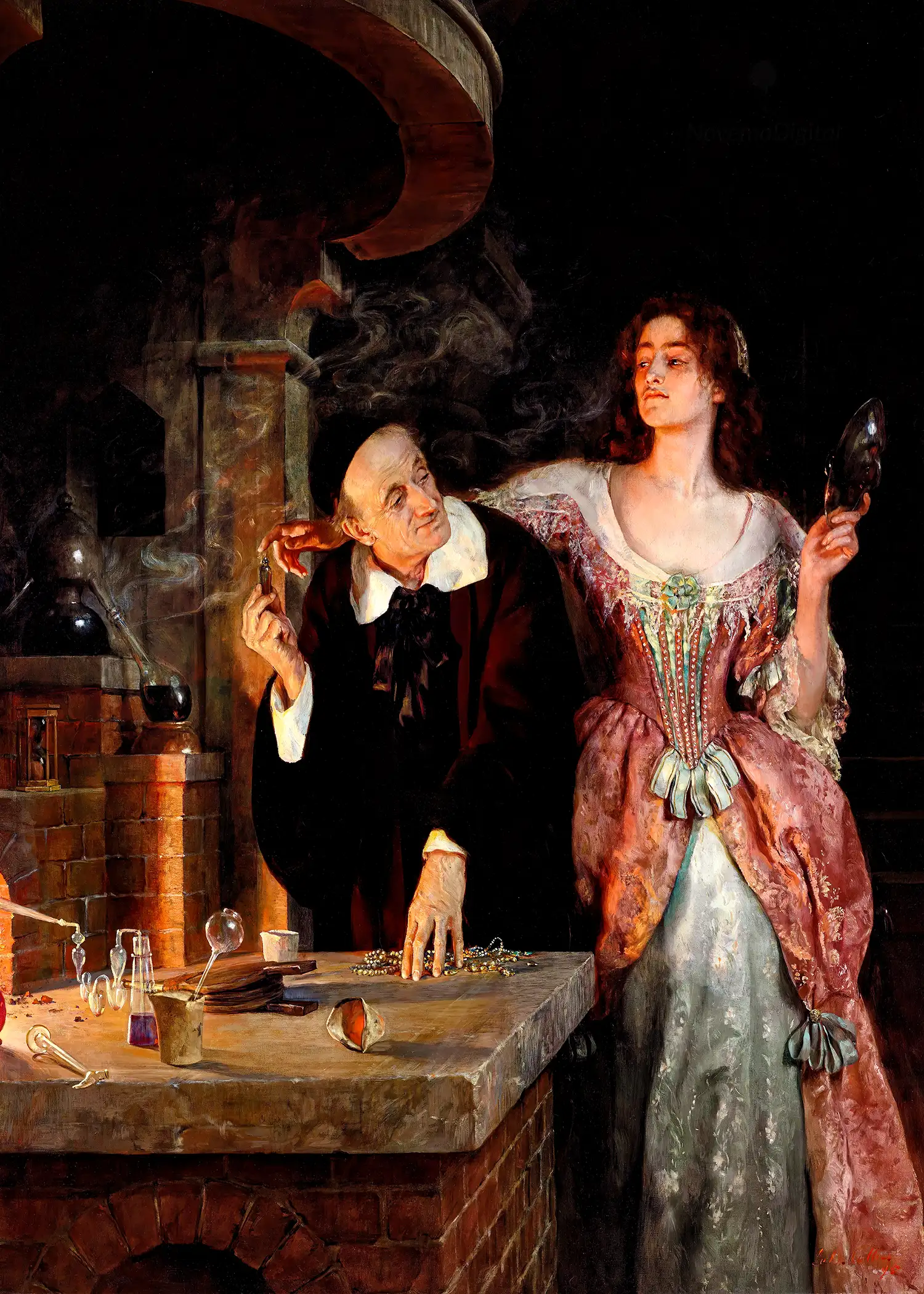
John Collier – The Laboratory (1895)
Original price was: $9.99.$4.99Current price is: $4.99.
John Collier – The Laboratory (1895)
Description
This work of art has been digitally enhanced without erasing signs of ageing for the sake of authenticity. Digital paintings are very popular right now as an affordable and stylish way to decorate and personalize your home and office.
John Collier – The Laboratory (1895)
“Chemical laboratories have existed since the late sixteenth century. Two basic designs have dominated this history: a furnace-centred laboratory based on earlier alchemical workshops up to around 1820 and then a design based on the use of the Bunsen burner with benches and bottle racks since the 1850s (the “classical” laboratory). New designs with a focus on health and safety began to appear at the end of the twentieth century. There has been an important interaction between the design of the laboratory and chemical practice, including how chemistry was taught. In particular, the introduction of running water and piped gas was crucial to the creation of the “classical” laboratory in the 1860s. One aspect of the classical laboratory which has disappeared is the chemical museum.
The chemical museum was not a science museum in the modern sense of the word and was not at all historical except accidently as the exhibits aged. They were more like modern geological or natural history museums with their scientific specimens. The first chemical museum was set up in Uppsala, Sweden, in 1769, but there were only a few museums in existence before 1850 after which they were to be found in many of the new laboratory buildings constructed in the second half of the nineteenth century. Their collections had three different strands and the degree to which one of these strands predominated depended on the origins and institutional setting of the museum. They contained chemical specimens made in the laboratory which could then act as reference specimens for later samples.
The first industrial research laboratories were set up in the 1860s in France and were soon followed by large laboratories in the Germany dye industry from the 1870s onwards. The style of these laboratories varied from company to company and probably even within companies. The research laboratories of BASF in Ludwigshafen were closely modelled on their academic counterparts, while the laboratory that the dye firm Bayer established in 1891 was rather utilitarian with more of a feeling of an industrial building. This was then followed by a pharmaceutical research laboratory as Bayer began to diversify from dyes to pharmaceuticals. These laboratories developed new products for the company and hence were seen as securing the firm’s future. By the 1920s, pretty well every chemical or pharmaceutical company had a research laboratory of some kind.”
After purchase you will have access to a PDF document with a link to these files available for download: 5×7”, 8×10”, 9×12”, 11×14”, 16×20″, 18×24″, 24×36″ and A1.
All files are in JPG format and at 300 PPI/DPI resolution. Please note that colours on your screen may be slightly different from the actual print.
This is not a physical item therefore nothing will be shipped to you.
Since these are printable downloads, refunds cannot be issued. Should you have any issues or questions please contact us and we will be happy to assist you.
For personal use only. Please do not use our digital art files for commercial use or resale.
© NovemaDigital
Only logged in customers who have purchased this product may leave a review.
Related products
-
Sale!

Franz Ludwig Catel – First Steps (1800s)
Original price was: $9.99.$4.99Current price is: $4.99. -
Sale!
Vincent van Gogh – Café Terrace at Night (1888)
Original price was: $9.99.$4.99Current price is: $4.99. -
Sale!
François-Louis Français – Gathering Olives at Tivoli (1868)
Original price was: $9.99.$4.99Current price is: $4.99. -
Sale!
Konstantin Korovin – Parisian Boulevard (1861 -1939)
Original price was: $9.99.$4.99Current price is: $4.99.




Reviews
There are no reviews yet.